
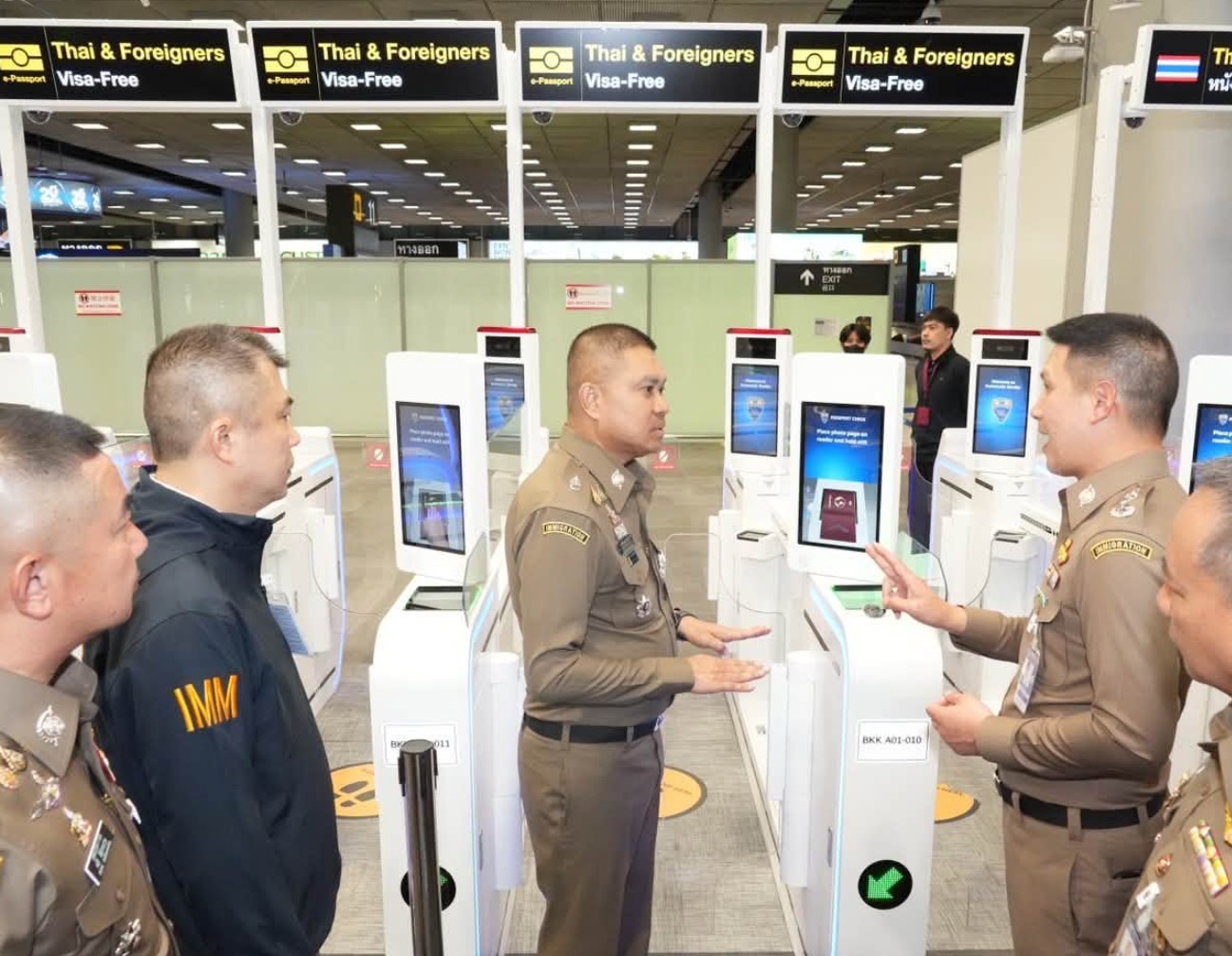
On his first day in office, the new Immigration Bureau Commissioner went to Suvarnabhumi Airport. He checked how passengers hit by flight cancellations and delayed baggage were being helped. He also inspected the Automated Border Control (ABC) gates and told officers to screen entries and exits strictly while staying courteous to legitimate travelers.
The new Immigration Bureau Commissioner’s message is firm on security and friendly on service. The ABC expansion, from 2 eligible nationalities to 33, is the most concrete part. Read alongside other recent policy changes, it gives a fairly clear picture of how Thailand wants to handle foreign arrivals in the coming years.
🔗 Thailand Arrival Auto Gates: Who Can Use Them and What Travelers Need To Know
Why the timing matters
The ABC expansion is part of a wider reset of Thailand’s entry system. Two developments stand out.
Congestion at the main gateway. Officials said Suvarnabhumi’s busiest window is 1pm to 5pm, when as many as 5,000-6,000 passengers per hour can enter immigration areas, straining counters, staff and space. International arrivals there average roughly 70,000 passengers a day. Officials expect that once the system is fully operational, about 53% of arriving passengers will be able to use the auto gates, with the other 47% processed by officers. Tourism authorities have said the expansion should cut congestion in immigration areas by more than 50 per cent.
Tighter visa-free rules. From 15 September 2026, the standard visa-free stay was halved to 30 days, and the eligible list was cut to 60 countries and territories. The 60-day scheme introduced in 2024 was repealed. The new exemption covers tourism only, so short-term business and work visitors from affected markets now need a visa.
So within a few weeks Thailand loosened the border process for some travelers and tightened the entry conditions for many. The new Commissioner’s “strict screening, courteous service” line fits this policy: faster for low-risk travelers, closer scrutiny for everyone else.
Who benefits from the ABC gates
Speed is the main gain. A traveler who qualifies can skip the staffed queue after a long flight, which is often the worst part of arriving in Bangkok. The conditions matter, though.
Eligibility is selective. The 31 added nationalities were selected using immigration rejection statistics, the Henley Passport Index and national security considerations. That is a risk-based filter, not a goodwill gesture. Reported lists include the UK, Canada, Australia and New Zealand. Passports from the United States, China, Taiwan and India are not included for now. Those travelers still use the regular queue, and they are among Thailand’s largest visitor groups. If the list expands again, they are the most likely next additions. Some may take that as a signal about how Thailand ranks risk and reciprocity, but the government has framed it as administrative and security-based.
Several conditions apply. According to Time Out Thailand, travellers must complete the Thailand Digital Arrival Card before arrival, first-time visitors must still use a staffed counter so biometrics can be collected, and the rollout is phased, so an eligible passport does not guarantee immediate access. For frequent visitors such as long-stay tourists, expatriates, digital nomads and business travelers, this makes the gates more useful over time, because once their biometrics are on file, later arrivals get faster. First-time tourists, the largest group, will not see an immediate difference.
The TDAC is the foundation. The digital arrival card is required of all foreign nationals. Reports say it must be submitted within 72 hours before arrival, regardless of visa type or exemption status. Thailand’s immigration process is becoming data-driven, and the pre-arrival declaration, biometric enrollment and automated gates work together. Travelers who skip or mishandle the first step lose the benefit of the rest. The Immigration Bureau has also warned about fake websites and scammers seeking fees or personal information, so visitors should use only the official TDAC site.
“Strict screening”: What it means in practice
 For most legitimate visitors the instruction to screen strictly will change little. For some groups it matters a lot.
Visa-exempt visitors who work. The new rules drop short-term work and business contact from the visa-free category. Foreigners who used the old scheme for informal work, remote work for Thai clients, or repeated border runs should expect more questions at the counter. Officers can ask about return tickets, accommodation, finances and the purpose of the visit. Having documents ready, such as onward travel and proof of funds, is now more important than before.
Long stays and repeated entries. A shorter exemption period means anyone planning more than 30 days needs an extension (about 1,900 baht at an immigration office, according to travel reporting), a pre-arranged tourist visa, or another long-stay route such as the Destination Thailand Visa for remote workers. Travelers who repeatedly leave and re-enter to reset their stay should expect scrutiny of their travel history.
Overstays and exit checks. The Commissioner’s order covered people leaving the country as well as those entering. Departures are where overstays surface, along with fines and possible blacklisting. With digital records and biometrics tied together, enforcement is more consistent than in the paper-stamp era.
Security-driven screening. The same data that speeds up low-risk travelers also lets officers focus on higher-risk ones. For most visitors this works in their favor, but it does mean treatment is no longer uniform across nationalities.
Service recovery and disruption support
The Commissioner’s focus on passengers affected by cancellations and delayed baggage matters for foreign visitors. Immigration cannot fix an airline’s problem, but it influences how a disrupted passenger experiences the airport: whether queues are managed, whether officers coordinate with airlines on stranded passengers, and whether visitors with changed itineraries can sort out their status quickly.
The practical points are:
- A cancelled flight can push an arrival into a crowded afternoon window or change the date entered on the TDAC. Travelers should update the card if their arrival date changes.
- Passengers whose bags are delayed still need to clear immigration normally. Airlines handle the baggage claim, but the Commissioner’s stress on close coordination suggests the bureau expects staff to cooperate with them.
- Disruption is more stressful with a visa-exempt stay of only 30 days. If a trip is delayed or extended, travelers should understand their permitted stay and extension options early.
Whether this coordination actually improves service is untested, since it comes from a single first-day inspection. Even so, it signals that arrival experience is now a stated priority.
How to read the policy overall
Combined with the visa changes, the inspection suggests a coherent approach. Thailand wants to remain easy to visit for tourists, who are central to its economy (about 17.36 million foreign tourists arrived between 1 January and 18 July), while tightening control over longer stays and non-tourist activity. Automation is the tool that allows both. It handles volume efficiently and leaves officers more time for travelers who need a closer look.
This benefits some travelers more than others. Short-stay, low-risk visitors from the favored nationalities gain the most. Those from excluded passports see no gate access for now and also face the 30-day rule. People who stayed in Thailand for months on the old scheme face the biggest adjustment.
Uncertainties and caveats
- Rollout details. Reports describe the expansion as phased, and eligibility lists and conditions have been described differently by different outlets. Early coverage cited 31 added nationalities without naming them, and later reports gave 33 as the total. Travelers should check the signage at Suvarnabhumi or the Immigration Bureau’s official channels rather than rely on secondary summaries.
- Airport scope. The news concerns Suvarnabhumi. Other airports, including Don Mueang, Phuket and Chiang Mai, and land borders, may not have equivalent gates yet.
- Policy volatility. Thailand has changed its visa rules several times in the past two years. The 60-day scheme lasted about two years before being reversed. Visitors should expect further changes.
- Gap between statements and practice. A new commissioner’s first-day instructions set the tone but do not guarantee consistent behavior at every counter. Individual experiences will vary.
Practical advice for foreign visitors
- Complete the TDAC accurately within the 72-hour window and keep the confirmation, using only the official site.
- Check your nationality’s status for ABC eligibility, the 30-day exemption and any visa requirement before booking.
- Plan the length of stay against the 30-day limit, and arrange an extension or visa in advance if you need longer.
- Match your activities to your entry status. Tourism fits the visa exemption. Work or business activity needs the right visa.
- Carry supporting documents: onward ticket, accommodation details and proof of funds.
- Enroll biometrics on your first visit if you are from an eligible country, so later trips can use the gates.
- Build in time during disruption and keep the TDAC and itinerary up to date if flights change.
Bottom line
The Commissioner’s first-day inspection is more than a ceremonial visit. It reinforces a policy direction of faster processing for low-risk, digitally registered visitors and stricter control of everyone else. For most tourists from the newly eligible countries, arrival at Suvarnabhumi should become noticeably easier from their second visit onward. For visitors planning longer stays, working informally or arriving on excluded passports, the picture is mixed and demands more preparation. The practical lesson for foreigners is to follow the digital process, understand the status of their entry and keep their paperwork in order.
Support your lifestyle choice with trusted solutions at Suvarnabhumi (BKK), Don Mueang (DMK), U-Tapao (UTP), Chiang Mai (CNX), Phuket (HKT), Krabi (KBV), Samui (USM), and Hat Yai (HDY). From helping you select the most suitable flights to supporting a smooth, low-stress arrival process, our goal is to make your entry into Thailand as comfortable and welcoming as possible.

Call/WhatsApp/Telegram:
+66-92-387-0335
Click to add LINE 💬

在微信上聊天
WeChat ID:
fasttrackvipth