
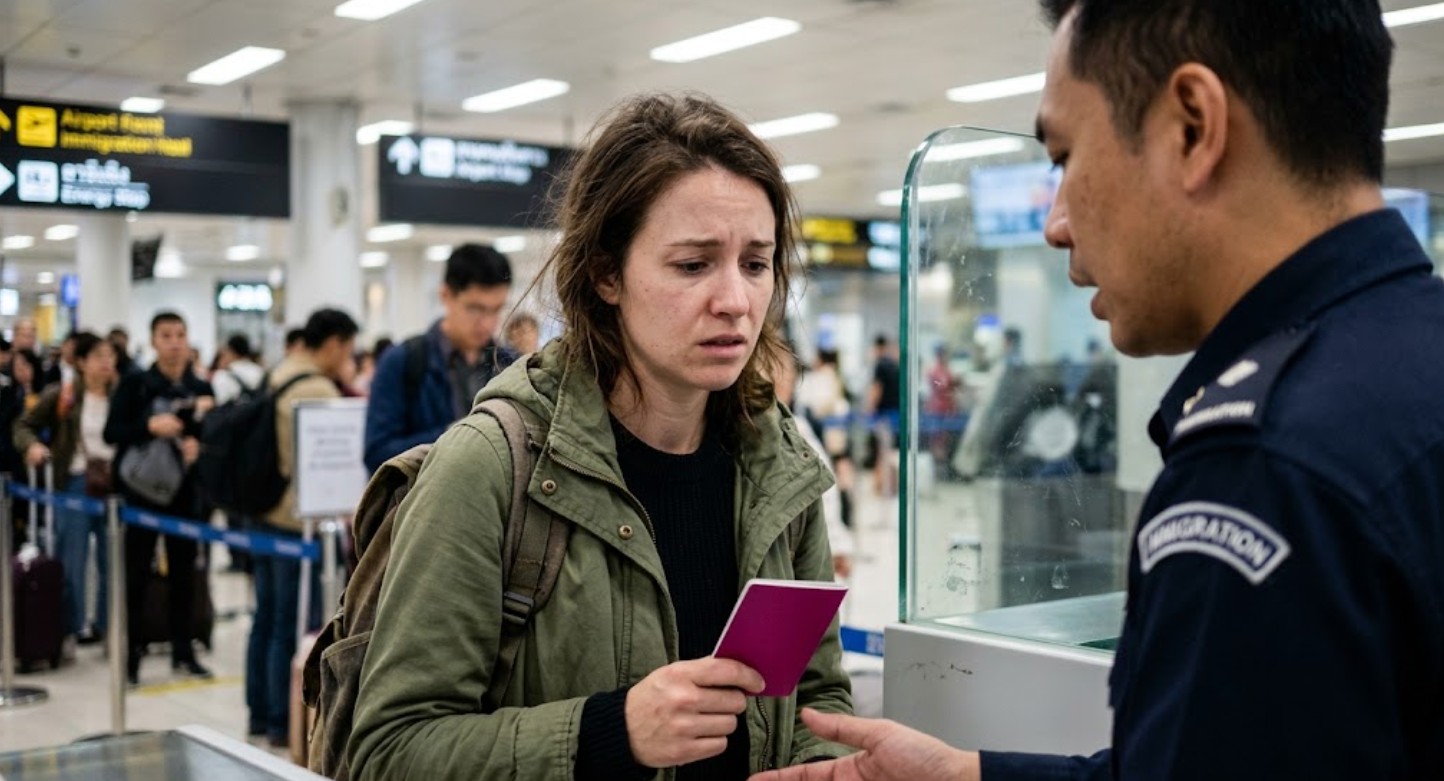
If you have scrolled through travel forums or expat groups this autumn, you have probably seen the same story repeated: a traveler lands in Bangkok, Phuket or Chiang Mai, answers a few questions at the immigration counter, and is sent back home on the next flight. Many of them say they broke no rule. Some blame the officer. Others blame the system.
This article looks at what is actually happening, what the law behind it says, and whether Thailand’s Immigration Act is fair, using South Korea’s Immigration Act as a yardstick.
Same core rule: Korea’s Article 12(4) lets an officer refuse entry if the traveler can’t prove they meet the conditions. That is the same logic as Thailand’s Section 12, so the two are comparable, which is refusal without proven wrongdoing.
Parallel structure: Both Acts have an entry inspection, a list of banned categories, carrier responsibility for sending people back, conditional entry with a bond, and short-term holding of people refused entry.
Regional parallel: Thai travelers have complained about being refused by Korea despite valid documents, and one report says Thailand is considering a Korea-style pre-approval system. So the two countries are already being compared in public.
Easy to compare on process: Korea’s Act states bond caps, notice duties, consular contact and detainee rights. That makes gaps in the Thai Act easy to see.
What is happening at Thai borders in September and October 2026
Two things have collided. The first is a long enforcement push. Thailand’s Immigration Bureau reported that 29,490 foreigners were refused entry between January and May 2026 under its “Three No’s” strategy: no entry, no stay, no escape. The Bureau said the campaign targets transnational crime, scam networks and illegal work, and that its blacklist held 169,506 names at that point.
The second is the rule change that took effect on 15 September 2026. After a Cabinet review in May, the revised measures were published in the Royal Gazette and ended the 60-day visa exemption. Under the new framework, around 60 countries and territories receive a 30-day, tourism-only exemption, and 21 nationalities lost visa-free entry altogether and must apply for an e-Visa before travel. Travelers who entered on or before 14 September keep the stay they were originally stamped.
One caveat matters for honesty: public data on denials specifically for September and October 2026 is thin. The Bureau’s published totals cover earlier months, so no one can yet say how many people were refused since the change. What exists is a flow of individual complaints and a lot of commentary. Treat any precise “September denial count” you see online with suspicion.
Why officers say they refuse entry
The reasons people are given, or infer, fall into a handful of buckets:
- No proof of funds. The Tourism Authority of Thailand (TAT) issued a reminder on 6 July 2026 that visitors may be asked for evidence of sufficient funds. It said the requirement has existed since 1980, with the current amounts set in 2000, and that the final decision rests with the officer at the checkpoint. The commonly cited figures are 20,000 baht per person or 40,000 baht per family for visa-exempt and tourist entries, and 10,000 baht for visa on arrival. Funds can be shown in Thai baht, foreign currency, or payment documents, but travelers report that cash is increasingly what officers want to see.
- A pattern that looks like living in Thailand. Officers look at travel history. Repeated back-to-back visa-exempt entries can trigger secondary questioning.
- Suspected work on a tourist entry. Laptop equipment, vague answers about plans, or client documents can raise suspicion of illegal work.
- Missing basics. No Thailand Digital Arrival Card (TDAC), no onward ticket, no accommodation details, or a passport with too little validity.
- Blacklist or security concerns. These are usually invisible to the traveler until the counter.
It is worth separating rumor from record. Several outlets claimed Thailand now allows only two visa-free entries a year. A fact-check published on 15 October 2026 could not find an official announcement creating a new general two-entry rule, and an earlier update from another outlet said plainly that visa-free entry is not capped at twice a year. What does seem true is that officers are using travel patterns as a signal, at their discretion.
Read more: Why was I denied entry to Thailand? 👆
“I did nothing wrong“: why that is a weak defense at the border
This is the heart of the complaint, so it deserves a direct answer. A refusal of entry is not a finding of misconduct. It is a finding that you did not meet the conditions of admission at that moment. In law, those are different things.
Section 12 of the Thai Immigration Act, B.E. 2522 (1979) lists the categories of aliens excluded from entry. They include people with no valid passport or required visa, people with “no appropriate means of living” on entering, people who enter to work as unskilled labor, people with certain diseases, and people “indicated under certain circumstances” as likely to engage in activities contrary to public order or good morals. None of these requires you to have committed an offense. The question is whether you satisfy the entry conditions, and the burden of showing it falls on you.
South Korea works the same way. Article 12(3) of its Immigration Act tells officers to permit entry only after checking that the passport and visa are valid, that the purpose fits the status of sojourn, that the period is set, and that the foreigner is not prohibited under Article 11. Article 12(4) then says that if a foreigner fails to prove that these requirements are met, the officer may refuse entry. In both countries, nobody has a legal right to enter. The border is the one place where the state may say no without proving you did anything wrong.
That does not make every refusal correct. Officers make mistakes, and some travelers are caught by fuzzy rules. But “I never broke the law” does not answer the legal question. A better question is whether the process that produced the refusal was transparent and reviewable.
Are the complaints about officers fair?
Both sides have a point.
The Immigration Bureau has rejected claims of arbitrary treatment. In March 2026, an Immigration Division 2 spokesperson said reports of forced ticket purchases and a 1,000-baht “service fee” were inaccurate, and that when someone is refused, the airline that carried them is responsible for arranging the return. In another widely shared case, the Bureau said its investigation found the traveler’s account did not match airport CCTV. Viral posts do sometimes get the facts wrong.
On the other side, the Thai Hotel Association’s president publicly criticized leaving entry control to individual officers’ discretion and random checks, and asked authorities to explain why particular social-media cases were refused. Travelers also describe being told the reason only at the gate, or not at all. That is a procedural problem, not a conspiracy. When the same document set gets one person in and another sent home, people assume bias, even when the cause is different answers, different histories, or a different officer’s judgment.
What the Thai Immigration Act actually says about refusals
The Act’s structure helps explain why this feels so uncertain.
- Section 12 sets out the exclusions. Several are crisp (valid passport and visa), but others are broad: “appropriate means of living” has no number in the statute, and the “likely to engage in” categories rest on officer judgment.
- Section 14 lets the Minister publish money or bond requirements. This is the legal hook for the funds figures, which therefore live in announcements, not in the Act’s text.
- Sections 19 and 20 let officers allow a person to stay somewhere while the case is examined, or detain them. Detention is limited to 48 hours, extendable to seven days with recorded reasons. Beyond that, the officer must apply to a court, which can authorize further detention in periods of up to twelve days and may order release on bail.
- Section 22 allows an appeal to the Minister against an exclusion order. It must be filed within 48 hours, and the officer must defer removal while the appeal is pending. If the Minister does not decide within seven days, the Act deems the person not prohibited. But the appeal is not available for refusals under Section 12(1), the visa and passport ground, or Section 12(10), a ministerial ban.
- Section 21 puts detention costs on the carrier or, failing that, on the alien.
On paper, then, Thailand does give a route to challenge some refusals. In practice, a traveler at a counter late at night, with a flight waiting and a 48-hour clock, is poorly placed to use it. The most common refusal grounds in the news, funds and suspected work, sit mostly outside the exceptions, so an appeal exists on paper, but nothing in the Act obliges officers to tell the traveler about it.
How South Korea’s Immigration Act compares
Note that the version discussed here is current to 2015, so later amendments and newer systems such as electronic travel authorization are not reflected.
Similarities.
- Officer discretion to refuse if the traveler cannot prove eligibility (Article 12(4)).
- A ban list. Article 11 gives the Minister of Justice power to bar people who may harm public health, safety or the economic or social order, and includes a ground for people who cannot afford their stay, which resembles Thailand’s means-of-living test. It ends with a broad catch-all for comparable persons.
- Carrier responsibility. Article 76 makes the captain or forwarding agent repatriate certain refused foreigners at their own expense, parallel to Thailand’s carrier-pays rules.
- Conditional entry. Article 13 lets a Regional Immigration Service commissioner grant conditional entry for special inspection, with a bond of up to ten million won, similar to Thailand’s Section 19 bond practice.
Differences that favor the traveler in Korea.
- Caps written into the Act. Korean bond ceilings (ten million won for conditional entry, twenty million for temporary release) are stated in the statute. Thai bond amounts under Section 19 are not.
- Notice and consular contact. Article 54 requires written notice of internment to family or counsel within three days and, if the person wishes, notice to their consul. The Thai Act as supplied has no equivalent.
- Rights language. Article 56-3 requires the human rights of detainees to be respected and prohibits discrimination, with special protection for patients, pregnant women, the elderly and minors. Article 56-8 gives a petition right with protection against retaliation. The Thai text contains no comparable clause.
- Short fixed holding for refused entry. Article 56 permits temporary internment of a person refused entry for up to 48 hours, extendable once by up to 48 hours.
Differences that favor Thailand.
- Thailand’s Section 20 brings in a court for detention beyond seven days at the border. Korea’s internment for deportation examination is ordered administratively by the Commissioner, with a ten-day limit extendable once by ten days (Article 52).
- Thailand’s Section 22 explicitly lets a refused person appeal to the Minister, with a deemed-approval rule if the Minister is silent. The Korean text offers objections against internment (Article 55) and deportation orders (Article 60, seven days), but no dedicated appeal against an entry refusal under Article 12(4). Other general administrative remedies may exist outside the supplied text.
Korea is also not immune to the same debate. In 2023 and 2024, Thai travelers complained of being turned back from Korea despite valid documents, prompting a Thai government review. That shows that “valid papers, still refused” is a global border phenomenon, not a Thai quirk.
So, is the Thai Immigration Act fair?
The honest answer is: fair in principle, thin in process.
The principle, that a state may refuse a foreigner who cannot show they qualify, is the same in Bangkok and Seoul. Thailand is not an outlier in refusing entry without proving misconduct. The 1979 Act also has real safeguards: a court check on longer detention, a ministerial appeal, and deemed approval if the Minister stays silent.
Where it falls short by comparison:
- Vagueness. Standards such as “appropriate means of living” and “indicated under certain circumstances” give officers wide latitude, and the numbers that guide them are in announcements travelers rarely read.
- Weak reason-giving. Nothing in the Act as supplied requires a written reason at the counter, and travelers report not being told why.
- A very short window to challenge. Forty-eight hours is tight, particularly for someone in an airport holding area.
- No rights framework for people held. Korea’s Act, in the supplied text, has explicit human-rights, notice and petition provisions.
- Rule changes that outrun communication. The 15 September overhaul, which cut stays, removed 21 nationalities from visa-free entry and restricted exemptions to tourism, came faster than most travelers’ awareness.
None of these require rewriting the Act. Thailand could publish a plain-language checklist of what officers may ask for, hand every refused traveler a written reason and an appeal notice, and speed up a pre-arrival authorization, which one report says the government is considering, similar to Korea’s electronic travel authorization. That would reduce arbitrary-looking refusals more than any statute change.
What travelers can do now
- Complete the TDAC within 72 hours before arrival.
- Check your nationality’s current category (30-day exemption, e-Visa, visa on arrival) with the Thai Immigration Bureau or a Royal Thai Embassy before booking.
- Carry proof of funds, ideally some cash in baht or foreign currency, a confirmed onward ticket and proof of accommodation.
- Be consistent and truthful about your purpose. If you work remotely, look at a visa designed for it, such as the Destination Thailand Visa, instead of relying on tourist entry.
- If refused, ask for the reason, keep any paperwork, and contact your embassy. A refusal on its own is not the same as a blacklisting.
This article is general information, not legal advice. Entry rules change quickly; confirm with official Thai sources before you travel.
Sources
- ASEAN NOW: Immigration Prevents Entry to 29,490 Foreigners in 2026
- KPMG: Thailand revised visa exemption, visa on arrival and entry funds rules
- TAT Newsroom: proof of funds reminder, 6 July 2026
- Khaosod English: Thai immigration slams Cambodian media over tourist mistreatment claims
- ToutelaThailande: many tourists turned away, vague rules worry
- Next Step Hua Hin: enforcement fact-check, 15 October 2026
- Pattaya Mail: Thailand’s immigration crackdown at airports
- SCMP: Why are Thai tourists often sent back by South Korea
- Statute texts: Immigration Act B.E. 2522 (1979), unofficial translation, and South Korea’s Immigration Act (Act No. 12782, text updated 2015)
Thai Free Visa: Feel free to reach out to us anytime. We are here to help whenever you need.
Click to add LINE 💬

Call/WhatsApp/Telegram:
+66-92-387-0335
在微信上聊天

WeChat ID:
fasttrackvipth