
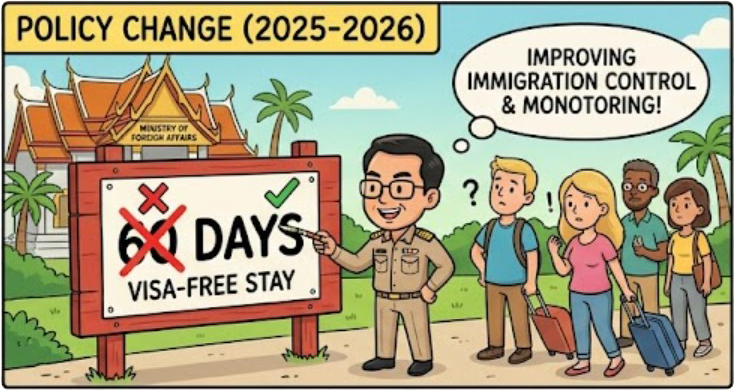
“Thailand Visa Policy Change 2026: 60 to 30 Days” – Thailand is planning to shorten the visa-free stay period from 60 days to 30 days. This means that tourists who currently can stay in the country without a visa for up to two months may soon be allowed to stay for only one month instead. As of early 2026, this proposal is still under discussion, but it reflects an important shift in policy direction following developments since the 60-day scheme was introduced in July 2024 [1].
The recent Thailand visa policy change has not happened suddenly. It has been discussed for some time because authorities have become increasingly concerned about how well immigration rules are being enforced [2]. In particular, there are questions about whether officials can effectively monitor who enters the country, how long they stay, and whether they follow the conditions of their entry.
The longer 60-day period, while convenient for tourists, has made it easier for some people to remain in Thailand without proper oversight.
The 60-day Period is Convenient for Tourists
The 60-day visa-free period is convenient for tourists because it gives them more time and flexibility during their stay without needing to deal with immigration procedures. First, it allows tourists to stay longer without applying for a visa. Many tourists, especially those coming from far away, prefer not to handle paperwork, visa fees, or embassy visits. With 60 days, they can enter Thailand and stay immediately without extra steps. Second, it suits different types of travel plans. Some tourists come for long holidays, slow travel, or to visit friends and family. A shorter period, such as 30 days, may feel too rushed, while 60 days gives them enough time to explore multiple cities or regions at a relaxed pace. Third, it reduces the need for extensions or visa runs. If the allowed stay is short, tourists often need to visit an immigration office or leave and re-enter the country to continue staying. A 60-day period lowers this need, making the experience easier and more comfortable. Finally, it provides a sense of security. Tourists do not need to worry about their stay expiring too quickly, so they can plan their trip with more confidence and fewer disruptions.
Because of these reasons, the 60-day period is seen as convenient for real tourists, even though it may also create challenges for immigration control.
However …
The proposed reduction shows that the current government, led by Anutin Charnvirakul, is taking a stricter approach to immigration control. The administration is not only focusing on tourism but is also trying to prevent misuse of the system. Some people have taken advantage of relaxed entry rules to engage in illegal activities, such as working without permits or participating in organized crime. In this context, underground operations refer to activities that are hidden from authorities and operate outside the law. These may include illegal employment networks, online scam operations, or other criminal businesses that use Thailand as a base. By shortening the visa-free stay period, the government aims to make it harder for such people to remain in the country for extended periods without being detected.
Thus, Thailand visa policy change reflects a balance between maintaining Thailand’s openness to tourists and strengthening control over who is allowed to stay and for how long.
However, at the heart of this debate is a key question: Can a shorter visa-free stay alone address the complex and deeply rooted issues?
The Original Objectives of the 60-day Visa Exemption Policy
The 60-day visa exemption policy began in July 2024 under the government of Srettha Thavisin. From that time, eligible tourists could enter Thailand without a visa and stay for up to 60 days. The policy was introduced shortly after the COVID-19 pandemic, when international travel was recovering but had not yet returned to normal levels.
The major purpose of this policy was to support and rebuild Thailand’s tourism sector [3]. During the pandemic, travel restrictions caused a sharp decline in tourist numbers, which affected many parts of the economy. By mid-2024, the government needed to encourage more tourists to return. Extending the visa-free stay made Thailand more attractive, especially for tourists who wanted longer holidays or flexible travel plans.
At that time, the policy was widely supported by businesses connected to tourism. Airlines needed more passengers, hotels needed higher occupancy, and restaurants and service providers depended on tourist spending. The longer stay period gave tourists more time in the country, which increased overall spending and helped these industries recover more quickly.
At the same time, the government expanded the list of countries eligible for visa-free entry. The number increased from 57 to 93 countries in 2024 [4], which meant that a much larger group of people could travel to Thailand without needing to apply for a visa in advance. Such a “Thailand visa policy change” made the country one of the most accessible destinations in the world [5]. Only a few countries, such as Singapore and Maldives, offered more open entry policies [6]. However, Thailand’s size creates a different situation compared to these smaller countries.
Because Thailand has a much larger land area and a wider range of destinations, tourists can travel freely across many regions once they enter. This makes it more difficult for authorities to monitor their movements and ensure they follow immigration rules.
In contrast, smaller countries, such as Singapore and the Maldives, have more controlled environments, where movement is easier to track. In Thailand, the combination of a large territory and increased tourist numbers has made enforcement more complex. This has raised concerns about whether immigration systems can keep up with the scale of travel under the expanded visa-free policy.
The Unintended Consequences
Although the policy was effective in increasing tourist numbers after its introduction in July 2024, it has also led to unexpected problems. In simple terms, while more people came to Thailand as intended, not all of them were real tourists or long-term tourists acting within the rules.
The number of arrivals rose quickly throughout late 2024 and into 2025, and this rapid increase placed pressure on immigration systems. Officials had to process more entries, monitor more people, and manage longer stays at the same time. As a result, weaknesses in enforcement became more visible. In particular, it became harder to check whether tourists were following the conditions of their stay or engaging in activities that were not allowed.
Some people have taken advantage of this situation by using Thailand as a base for illegal activities instead of visiting for tourism or remote work [7]. This means they enter legally under the visa exemption scheme but then remain in the country to carry out actions that break the law.
These groups include organized criminal networks, people working without proper permits, and people involved in online fraud operations. Such activities have been reported more frequently in 2024–2025, especially in areas close to Thailand’s borders, where enforcement can be more difficult. In this context, the visa exemption policy has unintentionally attracted people who do not match the government’s original target groups, which were mainly tourists, retirees, and skilled remote workers.
Another issue that has become more common during 2025 is the practice known as a visa run, referring to a situation where a person leaves Thailand briefly, often for just one day, and then re-enters to receive a new entry stamp, allowing them to stay again without applying for a proper visa. Although this practice is not always illegal, it is often used to avoid long-term visa requirements. The proposal to reduce the visa-free stay period to 30 days, therefore, is partly designed to limit such behavior. By shortening the allowed stay, the government aims to make repeated visa runs less practical and encourage people who wish to stay longer to apply for the correct type of visa instead.
Structural and Geographic Constraints
Thailand faces structural difficulties in controlling its borders. This is not a new issue as it has existed for many years and continues to affect immigration management as of 2025–2026. The country shares long land borders with neighboring states, and these borders are not always easy to supervise in a consistent and controlled way.
Although Thailand operates dozens of official immigration checkpoints [8], locations where tourists can legally enter and exit under the supervision of immigration officers, these checkpoints cover only part of the border. Large sections of the borders with Myanmar, Cambodia, and Laos stretch across mountains, forests, and rivers. These areas are often remote and difficult to access, which makes continuous monitoring challenging.
In addition to official checkpoints, there are many informal or natural crossing points. These are places where people can cross the border without passing through immigration control. Because they are not formally recognized, they are often outside effective surveillance systems. This means that authorities may not be able to track who is entering or leaving the country through these routes.
These conditions create an environment where illegal activities can take place more easily. For example, human trafficking networks may move people across borders without detection [9]. Similarly, people seeking to enter Thailand without proper documents may use these routes. In some reported cases in recent years, particularly between 2024 and 2025, such activities have involved the cooperation or negligence of local officials, which further weakens enforcement.
A significant number of unlawful entries, therefore, do not occur through official immigration channels at all. This is important because visa policies, such as reducing visa-free stay periods, only apply to people who enter legally through checkpoints. If people bypass these systems entirely, changes in visa rules have limited impact on controlling their movement. For this reason, while visa policy adjustments may help manage legal tourists, they cannot fully address the broader problem of border security on their own.
Policy Effectiveness Assessment
Reducing the visa-free stay from 60 days to 30 days may help address certain administrative issues. In practical terms, a shorter stay makes it easier for immigration authorities to monitor how long tourists remain in the country. As of early 2026, overstaying continues to be a concern, and limiting the permitted duration could reduce the number of people who remain in Thailand beyond their allowed time. It also allows officials to manage records more efficiently, since tourists would need to renew their status or leave the country sooner.
However, this measure is unlikely to stop people who already intend to break the law. People involved in illegal activities do not usually depend on standard visa rules in the same way as ordinary tourists. Even if the permitted stay is shorter, they may still find ways to remain in the country or re-enter it through alternative methods. Criminal networks, particularly those active in Southeast Asia during 2024–2025, are known for adapting quickly. They can change routes, methods, or locations in response to new regulations, which reduces the impact of policy changes such as shorter visa-free stays.
In addition, the original goal of the 60-day visa exemption, introduced in July 2024, was to attract what are often called high-value tourists. These include groups such as digital nomads, who typically look for stable environments where they can live and work remotely over a longer period. However, this objective has not been fully achieved.
Many of these tourists continue to choose other countries that offer clearer long-term visa options, more reliable legal frameworks, and stronger digital infrastructure, such as faster internet and better support for remote work. These factors are often more important to them than simply having a longer visa-free stay.
Instead, the policy has unintentionally attracted people connected to the informal economy. This refers to economic activities that are not properly regulated or are illegal. In Thailand, particularly during 2024–2025, this has included people involved in online gambling operations, digital fraud schemes, and other illicit sectors. These people may enter under legal visa conditions but then participate in activities that fall outside the law, which was not the intended outcome of the policy.
Systemic Gaps in Immigration Management
The root problem can be found in the limitations of Thailand’s immigration systems. When the 60-day visa exemption policy was introduced in July 2024, the Electronic Travel Authorization System, often referred to as an ETA, was not yet fully operational. This means that the system designed to collect and verify tourist information before arrival was either incomplete or not consistently used at that time. Because of this, gaps appeared in how data was collected and monitored.
In practical terms, authorities did not always have a complete or accurate record of who entered the country, how long they stayed, or whether they had already used the system before. These gaps made it easier for some people to remain in Thailand beyond their permitted period without being detected, particularly during late 2024 and into 2025, when travel volumes increased.
Another issue is the lack of full coordination between different immigration checkpoints. Thailand has multiple entry points, including airports and land borders, and not all of them are fully connected through a single, unified system. As a result, differences can exist between the data held at each checkpoint.
These discrepancies can be exploited by people who move between different entry and exit points. For example, a person might enter through one checkpoint and leave through another, or attempt to re-enter using a different location where their previous records are not immediately visible. This weakens overall control and makes it harder to track movement accurately.
To address this, stronger integration of databases is necessary. This means that all checkpoints should share the same system and update information in real time. If immigration officers can instantly access complete and consistent data across all locations, it becomes much easier to detect overstays, repeated entries, or suspicious travel patterns. At the same time, cooperation with neighboring countries is also essential. Thailand shares borders with several countries, and movement across these borders often involves more than one jurisdiction. By improving intelligence sharing, such as exchanging information about known risks or suspicious people, and coordinating enforcement actions, authorities can respond more effectively.
Joint efforts between countries, especially during 2025–2026, would help identify people who may pose a higher risk before they enter Thailand. This kind of regional cooperation strengthens overall border management and supports more effective immigration control beyond what any single country can achieve alone.
Broader Policy Considerations
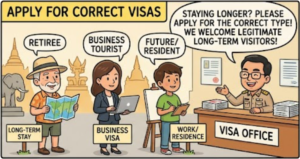
 The Ministry of Foreign Affairs in Thailand has expressed clear support for reducing the visa-free stay period from 60 days to 30 days. This position became more visible during policy discussions in late 2025 and early 2026, as concerns about immigration control increased. At the same time, the Ministry continues to emphasize that people who wish to stay in Thailand for a longer period should apply for the correct type of visa, rather than relying on repeated short-term entries. Long-term tourists, such as retirees, business tourists, or people planning to live in Thailand, are expected to use specific visa categories designed for their purpose. By doing so, the government can better monitor their activities and ensure that their stay complies with Thai law.
Despite the proposed reduction in visa-free stay duration, Thailand is not closing its doors to foreign tourists. The country remains open to groups that are considered beneficial to the economy and society. These include retirees who contribute financially through long-term residence, as well as other legitimate long-term residents who follow the legal requirements of their visas.
Another important issue in this discussion is visa reciprocity. This refers to whether countries offer similar entry privileges to each other. At present, Thai passport holders can travel visa-free to fewer countries than the number of nationalities allowed to enter Thailand without a visa. In other words, Thailand provides relatively open access to foreign tourists, but Thai citizens do not always receive the same level of access in return. According to the Henley & Partners Passport Index, which was last updated in 2025, Thailand ranks below several countries in the region in terms of travel freedom. This includes countries that allow their citizens to enter more destinations without a visa.
This difference highlights an imbalance in international travel rights. As a result, policymakers in Thailand may need to consider whether current visa policies should be adjusted, not only to manage immigration more effectively but also to improve reciprocal arrangements for Thai citizens travelling abroad.
Conclusion
 The proposal to reduce the visa-free stay period from 60 days to 30 days, which has been actively discussed in late 2025 and early 2026, is an important step, but it has clear limits. It is considered necessary because it can help the government regain some control over how long tourists remain in the country. However, it is only a partial solution. It does not solve the deeper, structural problems that exist within Thailand’s immigration system.
In the short term, a shorter stay period may improve administrative control. For example, it can reduce the number of people who remain in Thailand for extended periods without proper authorization. It also allows immigration officers to monitor tourists more closely. However, these improvements mainly address surface-level issues and do not fix the underlying weaknesses in border management, data systems, and enforcement.
To achieve a more effective and lasting solution, several areas need to be strengthened. First, border enforcement must be improved. This means increasing the ability to monitor both official checkpoints and informal crossing areas, especially along land borders. Without stronger control at these points, people can continue to enter or move across borders without detection.
Second, digital immigration systems need to be better integrated. As of 2024–2025, gaps in data systems have made it difficult to track tourists accurately. A unified system that shares information in real time across all entry points would allow authorities to identify overstays, repeated entries, and suspicious patterns more effectively.
Third, visa categories should be clearer and more specific. Different types of tourists, such as tourists, retirees, and long-term residents, have different purposes for staying in Thailand. By offering well-defined visa options, the government can guide people into the correct legal pathways instead of relying on short-term exemptions.
Finally, closer international cooperation is essential. Working more closely with neighboring countries through shared data, intelligence, and joint enforcement efforts can help identify high-risk people before they enter Thailand. This is particularly important given regional movement patterns in 2025–2026.
By focusing on these areas, Thailand can create a more balanced immigration system. The goal is not to reduce tourism, but to ensure that the country continues to welcome real tourists while preventing those who intend to misuse the system from taking advantage of it.
Support your lifestyle choice with trusted solutions at Suvarnabhumi (BKK), Don Mueang (DMK), U-Tapao (UTP), Chiang Mai (CNX), Phuket (HKT), Krabi (KBV), Samui (USM), and Hat Yai (HDY). From helping you select the most suitable flights to supporting a smooth, low-stress arrival process, our goal is to make your entry into Thailand as comfortable and welcoming as possible.

Call/WhatsApp/Telegram:
+66-92-387-0335
Click to add LINE 💬

在微信上聊天
WeChat ID:
fasttrackvipth
References
[1] Royal Thai Consulate-General, Los Angeles, “Visa Exemption and Visa on Arrival to Thailand,” 2023. [Online].
[2] Khaosod English, “THAILAND TO SLASH VISA-FREE STAY FROM 60 TO 30 DAYS AMID SECURITY CONCERNS,” 2026. [Online].
[3] Foreign Affairs Office, The Government Public Relations Department, “Thailand Reduces Visa-Free Stay to 30 Days,” 2025. [Online].
[4] Foreign Affairs Office, The Government Public Relations Department, “Thailand expands visa-exempt entry from 57 to 93 countries Effective 15 July,” 2024. [Online].
[5] Tourism Authority of Thailand, “Visitors from 93 countries will now be able to enjoy visa-free entry to Thailand,” 2024. [Online].
[6] P. Carlisle, “Rethinking Thailand’s visa-free policy,” 2026. [Online].
[7] Bangkok Post, “Thailand reviewing visa-free stays as local complaints pile up,” 2026. [Online].
[8] The Government Public Relations Department, “The authorized channels for immigration checkpoints that can issue a visa on arrival (VOA),” 2023. [Online].
[9] United Nations Office on Drugs and Crime, “Understanding the hidden links between human trafficking and corruption,” 2026. [Online].