
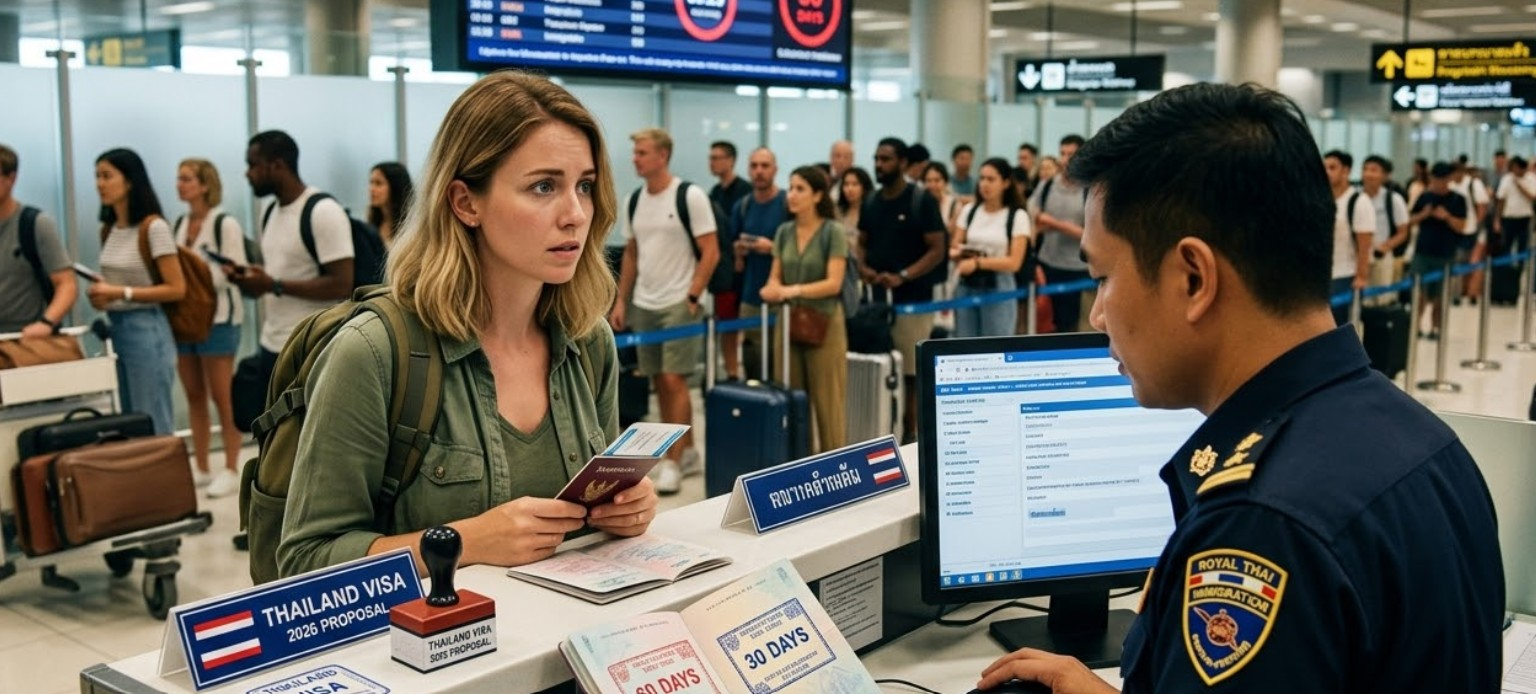
Thailand Plans to Cut Visa-Free Stay from 60 to 30 Days: What It Means for Tourists, Visa Runners, and Long-Stay Visitors
Thailand’s Ministry of Foreign Affairs has proposed reducing the visa-free stay for foreign tourists from 60 to 30 days, while still allowing a 30-day extension. The policy, announced in March 2026, is not yet approved but is under government review as part of a broader effort to tighten immigration controls.
The change comes after authorities found that the current 60-day visa exemption, introduced to boost tourism[1] [2], has been widely misused[3]. Officials say some foreign nationals have used the extended stay to live long-term, run businesses illegally, or participate in online scam networks[4]. The government believes 30 days is sufficient for real tourism and would help close these loopholes.
In addition to shortening the stay, Thailand is increasing inspection at entry points. Tourists may be required to show return tickets, hotel bookings, and proof of travel plans. Authorities are also moving to restrict visa runs, where visitors exit and re-enter the country to reset their stay period.
For most tourists, the impact is expected to be minimal, as average trips are typically under two weeks. However, long-stay visitors, digital nomads, and visa runners may face stricter enforcement and reduced flexibility.
The proposal reflects a shift in Thailand’s strategy, from maximizing tourist numbers to improving security, regulating illegal activity, and ensuring visitors use the correct visa types. While the country remains open to tourism, it is moving toward tighter control and more structured immigration policies.
The Decision Makers and Stakeholders Shaping the Changes
At the center of a proposal to reduce Thailand’s visa-free stay from 60 to 30 days is the Ministry of Foreign Affairs, represented by Foreign Minister Sihasak Phuangketkeow[5]. Sihasak is the public face of the proposal and the official explaining why the ministry wants to revisit the current visa exemption regime. The proposal also sits within a wider government structure. The Ministry of Foreign Affairs appears to be acting in its role as chair of the committee that reviews visa policy, but the final decision does not belong to the ministry alone. Several reports make clear that the matter must still go through the Thai government and, crucially, that Cabinet approval has not yet been granted. That means the ministry is the proposer, not yet the final decision-maker.
Other important actors include the Immigration Bureau[6], which is tightening enforcement at the operational level, and the tourism authorities and private-sector tourism associations[7], which are reacting to the issue from a business perspective. Hotel and tourism industry representatives are especially relevant because they are not opposing the review in principle. Instead, some of them explicitly support shortening the visa-free period, arguing that real tourists usually do not need as long as sixty days and that the longer period has created loopholes. This is politically important, because it shows the debate is not simply government versus business. Some parts of the tourism industry appear to believe that stronger controls may actually help protect the long-term credibility of Thai tourism.
The affected population is broad. It includes ordinary tourists from the 93 countries and territories currently enjoying visa exemption, long-stay leisure tourists, retirees who may be using tourist status as a temporary solution, remote workers or informal digital nomads, short-term business visitors who rely on tourist entry, landlords and property operators, local Thai hotel owners, local workers, and, according to the reporting, also criminal actors such as online scammers or foreign groups engaging in unlawful business activity. In other words, this is not only a tourism story. It is also a labor, property, security, immigration, and governance story.
A final group worth noting is the foreign public itself. The proposal is being explained in a defensive but careful tone. Thai officials repeatedly stress that the measure is not aimed at any one nationality and is not a form of selective discrimination. That repeated reassurance matters because the government seems aware that foreign tourists, embassies, investors, and international media may interpret a reduction in visa-free stay as a sign that Thailand is becoming less welcoming. The official messaging therefore tries to separate welcome to tourists from tolerance of loophole abuse.
Cutting Visa-Free Stay from 60 to 30 Days to Tighten Entry Rules and Close Loopholes
Thailand is considering reducing the visa-exempt duration for foreign visitors from 60 to 30 days, reflecting a new approach to tourist stays. Under the current system, tourists from 93 countries and territories can enter Thailand without applying for a visa in advance and remain for up to 60 days. They may also seek an extension, allowing their total lawful stay to reach as much as 90 days. The proposed revision would reduce the initial visa-free period to 30 days, while still allowing an additional 30-day extension under the existing process. In practical terms, that means the government would not be eliminating flexibility entirely, but it would be reducing the automatic period granted on arrival.
This is an important distinction for foreigners. The proposal is not framed as ending visa exemption. Nor is it framed as banning longer stays outright. Instead, it changes the default assumption. At present, a tourist can receive 60 days without any additional inspection beyond standard entry checks. Under the proposed model, a tourist would receive 30 days automatically and would need to take further action if they wished to remain longer. That creates an extra administrative step and, more importantly, a point at which the authorities can assess whether the person’s stay still appears consistent with tourism.
The visa-free scheme itself has become entangled with several related issues. These include illegal work, foreigners using Thai nominees to operate businesses, unlawful short-term rentals, quasi-residential use of tourist entry, and criminal activity linked to scam operations in Thailand and neighboring countries. Because of that, the proposal is being presented not as a narrow immigration technicality but as part of a broader attempt to close structural loopholes. In that sense, the reduction from 60 to 30 days is both a policy change and a signal. It says that the government believes the current system has become too permissive in ways that go beyond leisure travel.
Another notable element in the reporting is that the proposal appears to sit alongside tighter document and enforcement expectations. Reports mention requirements such as return air tickets and hotel booking confirmation, as well as inspection of those seeking medium- to long-term stay under other visa categories. It also refers to pressure against so-called visa runs. Taken together, the proposal is not merely about counting fewer days. It points to a shift in enforcement philosophy: less tolerance for ambiguity, more insistence that visitors fit the legal category they are using.
The Reasons Behind Thailand’s Visa Policy Shift
The proposal to reduce Thailand’s visa-free stay from 60 to 30 days is officially framed as a response to concerns that the current duration is too long for real tourists and too easily misused, but it is driven by several deeper motivations. The official reason is simple: sixty days is viewed as too long for most real tourists and too useful for those entering Thailand for the wrong reasons. But behind that simple line are several more specific motivations.
The first is security. The reporting repeatedly refers to online scammers, transnational criminal groups, and activities that threaten national security. Thai officials appear to believe that a longer visa-free period gives bad actors more room to operate, build contacts, and move between Thailand and neighboring countries. Even if only a minority abuse the system, the state seems to think the cost of that abuse is now too high. This is one of the clearest themes in reports: visa policy is no longer being treated as only a tourism convenience issue. It is being reframed as a security instrument.
The second reason is the misuse of tourist status for long stays and quasi-settlement. Officials and some industry voices argue that people who really intend to stay in Thailand for a long period should apply for the appropriate visa, rather than using an extended tourist privilege as a substitute. The language used in the reports is telling: people are said to be settling, dominating businesses, or using loopholes rather than simply traveling. This suggests a deeper frustration with category misuse. Thailand is not saying that foreigners cannot stay longer. It is saying they should do so under the correct status and with the correct inspection.
The third reason is economic protection and fairness. Reports highlight concerns that some foreigners are operating businesses illegally, relying on Thai nominees, buying or controlling multiple properties, and competing in ways that disadvantage lawful Thai operators. The issue is not presented solely as a matter of nationality. It is also framed as a matter of illegal market behavior. If a foreign visitor comes for tourism, that is welcome. If the same person uses tourist status to work, trade, rent out properties daily, or structure de facto business operations, officials and industry representatives regard that as a distortion of the economy and of the purpose of visa exemption.
The fourth reason is administrative realism. Several industry voices argue that most real tourists stay fewer than 15 days and that 30 days is already more than enough for normal leisure travel. From this perspective, 60 days is not necessary for the mainstream tourism market. If so, shortening the automatic stay would impose little burden on ordinary tourists while making it harder for non-tourism users to exploit the system. Whether that assumption is fully correct is open to debate, but within current reports it is clearly a central policy justification.
The fifth reason is image and trust. Thailand wants to preserve its reputation as a welcoming destination, but it also wants to avoid being seen as an easy jurisdiction for unlawful activity. Reports suggest that problems linked to free-visa abuse may affect both national security and the country’s image. That combination is politically sensitive. A state that appears too lax risks looking weak. A state that tightens entry too sharply risks looking unfriendly. The proposal tries to navigate between those two risks.
When It Happened and What Comes Next
The current debate over reducing Thailand’s visa-free stay from 60 to 30 days was triggered by public statements made on 20 March 2026, followed by wider media coverage on 21 and 22 March 2026. This timing matters because it shows the proposal is fresh and politically active, but not yet settled. Reports also refer back to the earlier history of the policy. The 60-day visa exemption has been introduced under former Prime Minister Srettha Thavisin’s government, with implementation linked to the post-15 July 2024 expansion of visa exemption for 93 countries and territories. That earlier move was clearly intended to stimulate tourism and the wider economy.
The more recent timeline shows a progression from policy optimism to policy review. One section says that over the six months from 15 July 2024 to 15 January 2025, authorities reviewed the effectiveness of the 60-day scheme and gathered concerns. Another section notes that on 10 February 2026, the Cabinet acknowledged a report on visa measures and the Ministry of Foreign Affairs raised concerns that the 60-day exemption had created security and reputational problems. This suggests that the March 2026 proposal did not emerge suddenly. It appears to be the result of months of internal review, data collection, and growing political pressure.
At the same time, one of the most important facts for foreigners is that the change is not yet in force. Several reports expressly state that the idea has not been approved by Cabinet and remains under consideration by the relevant agencies. That means no tourist should treat the proposed 30-day limit as an already effective rule, at least not on the basis of current reports. The current legal position is that the 60-day exemption still stands until the government formally changes it.
There is also an interesting policy rhythm in the background. The reporting shows that the government is not only reacting to one news event. It is conducting a wider overhaul of visa administration, including e-Visa expansion, reform of non-immigrant visa categories, and a digital arrival card system. So, the present debate about free-visa days should be read as part of a longer transition in Thai border governance. The sixty-day period may have been a politically generous phase tied to economic recovery, while 2026 appears to mark a more security-conscious and compliance-oriented phase.
Key Areas Driving the Change
Formally, this concerns Thailand as a whole, because the visa exemption policy is national in scope and applies to foreign entry into the country. It affects all Thai international airports, seaports, and land checkpoints. Yet the practical geography of the issue is more specific and more revealing. The proposal is heavily shaped by what happens in tourist hubs, border areas, major cities, and places with high concentrations of foreign property use and informal foreign-run services.
Bangkok and Phuket appear especially prominent in the discussion. Reports mention illegal daily rentals in condominiums, with Bangkok and Phuket mentioned as problem areas. In Phuket, some foreign owners are said to be renting out condos and pool villas to tourists from their own countries. In Bangkok, both Thai and foreign actors are purchasing rooms or even entire floors in condominium buildings for unlawful short-term rental activity. Pattaya and Chonburi are also referenced in relation to nominee structures and hotel operations geared to group tours. These examples show that the government’s concern is not abstract. It is tied to identifiable urban and resort markets where tourism and residency blend together.
The regional dimension is equally important. Several passages link Thai visa policy to criminal movement involving neighboring countries. The authorities are concerned not only that foreign nationals enter Thailand under tourist status, but that Thailand may be used as a base or transit point for illegal operations connected to nearby states. This means the issue sits within mainland Southeast Asia’s cross-border security environment, especially in the context of scam compounds and transnational fraud. So, even though the legal rule concerns entry to Thailand, the strategic concern stretches beyond Thailand’s borders.
There is also a symbolic where embedded in the story: the zone between tourism and settlement. The government appears worried that the current rules allow some foreigners to use Thailand not just as a vacation destination but as a low-friction place to live, work, operate businesses, or build semi-permanent networks without switching into the correct legal category. In that sense, the relevant location is not only physical. It is regulatory. The state is trying to redraw the boundary between tourist presence and de facto residence.
How Thailand’s 30-Day Visa Policy Will Work in Practice
The proposed change would work in a layered way. The first layer is the legal adjustment itself: reducing the automatic visa-free period from 60 to 30 days. The second layer is procedural: tourists who need to remain longer would still have the option to apply for a 30-day extension. The third layer is enforcement: tighter checks at the border and greater inspection of travel purpose, documents, and patterns of movement.
That third layer is crucial. Reports indicate that the Immigration Bureau has already become stricter in reviewing entry conditions. Tourists may be expected to show a return ticket and proof of hotel accommodation. Such requirements are not unusual internationally, but they become more consequential in an environment where authorities are actively looking for misuse. A tourist whose story, documents, or travel history do not fit a tourism profile may face more questions than before.
The reporting also says that visa runs are being targeted. In common usage, a visa run means leaving Thailand briefly, often to a neighboring country, and re-entering in order to reset a period of lawful stay. According to reports, the authorities want to stop some people from leaving to a nearby country and returning simply to start the visa-free clock again. One passage even says that such individuals would have to return to their own country rather than just cross a nearby border and come back. Even if the practical application of that principle may vary, the message is clear: the government wants to break the habit of circular short exits used to prolong residence without the correct visa.
The policy also seems to fit into a more digital and centralized immigration environment. The text mentions e-Visa expansion, non-immigrant visa code reform, and the Thailand Digital Arrival Card system. For foreigners, this suggests that the state is moving toward a more integrated immigration architecture. That matters because loopholes often survive where systems are fragmented. As border records, visa categories, and arrival data become more organized, it becomes easier for the authorities to detect repeated entries, suspicious patterns, or mismatches between declared purpose and actual behavior.
In practical terms, the government’s approach can be summarized as moving the decision point closer to the tourist. Instead of giving almost everyone sixty days automatically and asking questions later, the state wants to grant a shorter automatic stay, require more justification for longer presence, and make it less convenient to use tourism entry as a substitute for another immigration pathway.
What Foreigners Should Notice About Thailand’s Visa Changes
Several parts of the proposal are especially interesting to foreign visitors. One is that the tourism industry is not uniformly lobbying for maximum leniency. Some hotel and tourism groups are in fact urging the government to reduce the visa-free period to 30 days. That is unusual in a sector that typically favors easier entry. Their support suggests that industry actors see the issue not only in terms of arrival numbers, but also in terms of quality control, illegal competition, and public confidence in destination safety.
Another interesting point is the distinction between formal openness and practical closure. Thai officials repeatedly say the country remains committed to welcoming tourists. On paper, that is true, because visa exemption would continue, and an extension path would remain available. But in practice, the policy would make Thailand less convenient for those who rely on flexibility, informal long stays, or repeated re-entry. So, the same measure can truthfully be both still open and more restrictive, depending on the tourist’s profile.
A third interesting point is that the state appears to be correcting what may have been an over-generous recovery policy. The 60-day measure made sense when the goal was to stimulate tourism quickly and send a strong signal of openness. But once concerns emerged about abuse, security, illegal work, and informal settlement, the same generosity began to look like a loophole. This is a classic example of how emergency-style liberalization can create second-order policy problems later.
A fourth point is that the debate reveals tensions inside Thailand’s development model. The country wants high visitor numbers, foreign spending, strong international connectivity, and a reputation for hospitality. At the same time, it wants control over labor markets, local business ownership, residential order, and security. The visa debate exposes how difficult it is to maximize both openness and control at once.
The End of Visa Runs? Who Wins and Who Loses in Thailand’s New Policy
For visa runners, the implications are the clearest and probably the most severe. Reports strongly suggest that the authorities now view visa runs as part of the problem, not as a tolerated workaround. If the initial visa-free stay is cut from 60 to 30, the payoff from each re-entry becomes smaller. If repeated entries are scrutinized more aggressively, the risk goes up. If tourists are expected to return to their home country rather than simply make a quick border trip, the model becomes much less practical and much more expensive.
That matters not only for obvious abusers, but also for those who may have normalized visa runs as an informal way of living in Thailand. Some may be retirees waiting to switch categories, some may be remote workers without a clear legal route, some may be accompanying partners, and some may simply prefer not to commit to a more formal visa. Whatever their motives, the direction of policy is unfavorable to them. The state is signaling that tourism entry is for tourism, not rolling residence.
There is also an important psychological implication. Once a government publicly names visa runs as a loophole associated with broader concerns about illegal business and security, officers on the ground are more likely to interpret repeated border crossing patterns negatively. That means even before a formal change takes effect, the climate of enforcement may already become less forgiving.
For ordinary tourists, the impact may be limited if they are traveling for a standard holiday. Most short-term tourists will still have enough time. For them, the bigger issue may be documentation: keeping proof of accommodation, onward travel, and a clear itinerary. For long-stay leisure tourists, however, especially those who enjoy spending one or two months in Thailand without dealing with visa formalities, the proposal would reduce convenience.
For digital nomads and remote workers operating informally under tourist status, the proposal is a warning. Even if they are not the main target, they belong to the gray zone the state is trying to shrink. Thailand appears to be saying that longer presence and economic activity should be matched with the correct visa type, not hidden inside repeated tourist entry.
For lawful tourism businesses such as hotels, the measure may be positive if it reduces illegal daily rentals in condos and villas. For landlords and property operators who benefit from the current ambiguity, it may be negative. For Thai workers and small entrepreneurs, the government is implicitly promising fairer enforcement against unlawful competition. For embassies and travel planners, the main challenge will be communicating clearly that the policy is proposed but not yet approved.
Conclusion
Based on current reports, the proposed cut from 60 to 30 days is best understood as a proposed tightening, not a finalized shutdown. Thailand is not abolishing visa exemption, and it is not declaring itself closed to foreigners. Rather, it is trying to shorten the automatic period of stay, preserve the option of extension, and use that structure to separate ordinary tourists from those the government believes are exploiting a generous system for other ends.
The proposal reflects a broader political judgment: sixty days may have helped stimulate tourism, but it also appears to have made Thailand too easy to use for long informal stays, illegal business, property misuse, visa-run residency, and possibly criminal networks. The official answer is to restore a shorter default period and rely more heavily on screening and extensions. For real tourists, the change may be manageable. For visa runners and others living in the gray areas of Thai immigration law, it could be a major disruption.
Support your lifestyle choice with trusted solutions at Suvarnabhumi (BKK), Don Mueang (DMK), U-Tapao (UTP), Chiang Mai (CNX), and Phuket (HKT). From helping you select the most suitable flights to supporting a smooth, low-stress arrival process, our goal is to make your entry into Thailand as comfortable and welcoming as possible.

Call/WhatsApp/Telegram:
+66-92-387-0335
Click to add LINE 💬

在微信上聊天
WeChat ID:
fasttrackvipth
References
[1] Bangkok Post, “30-day visa-free stay ‘sufficient’, says minister,” 2026. [Online].
[2] Arabian Business, “Thailand approves longer visa stays for tourists, students, digital nomads to boost economy,” 2024. [Online].
[3] Travel And Tour World Magazine, “Bangkok, Phuket, and Chiang Mai To Face Travel Chaos as Thailand Cuts Visa-Free Stay: What Travellers Need to Know about This New Rule,” 2025. [Online].
[4] The Pattaya News, “Thailand Considers Reducing Visa-Free Stay to 30 Days, No Final Decision Yet,” 2025. [Online].
[5] Khaosod English, “THAILAND PLANS TO CUT VISA-FREE STAY FOR FOREIGNERS FROM 60 TO 30 DAYS,” 2026. [Online].
[6] Khaosod English, “THAILAND TO SLASH VISA-FREE STAY FROM 60 TO 30 DAYS AMID SECURITY CONCERNS,” 2026. [Online].
[7] Bangkok Post, “The Ministry of Foreign Affairs has confirmed it will propose reducing the visa-free stay for foreign tourists in Thailand from 60 days to 30 days in a bid to curb abuses and mitigate potential security threats.,” 2026. [Online].