
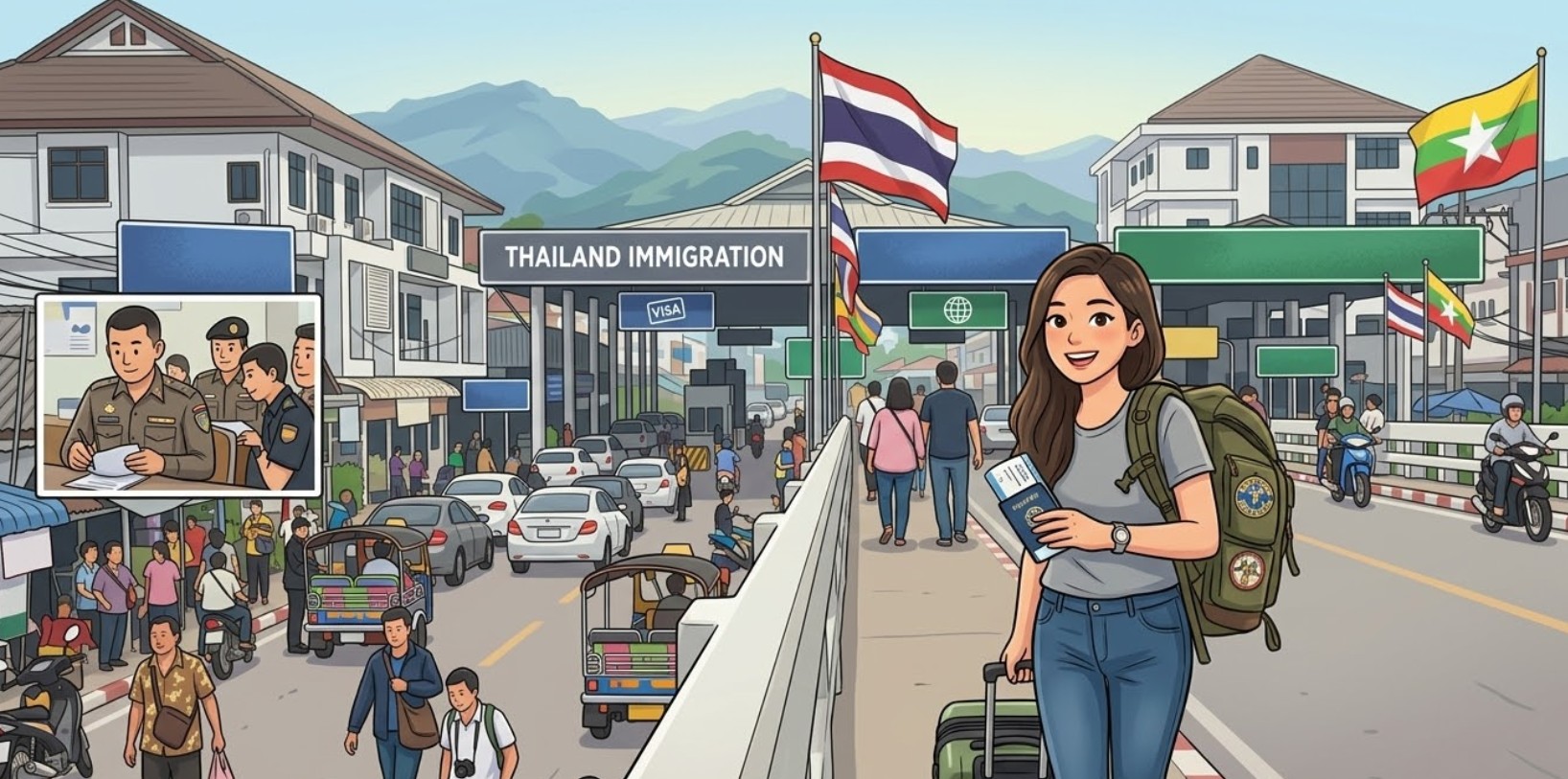
What Travelers Should Know: Thailand Visa Run Rules in 2026
In recent years, many foreign travelers have used a method called a visa run to stay longer in Thailand. According to Thailand’s Ministry of Tourism and Sports, the country welcomed about 28 million international visitors in 2023 [1]. Immigration data also shows that thousands of foreigners entered Thailand multiple times in the same year [2], especially through land borders with Malaysia, Laos, and Cambodia [3]. For example, some border checkpoints reported tens of thousands of repeat entries every month. Many travelers leave the country for a short time and return on the same day to receive a new visa-exempt stamp, which usually allows them to stay 30–60 more days. Because of this pattern, Thai immigration officers have become more careful and now check travelers who enter the country many times in a short period.
A visa run usually means leaving Thailand for a short time and then returning again using a visa exemption, often called free visa. Some people travel to a nearby country for a few hours or a few days and then come back to Thailand to receive a new period of stay.
However, Thailand’s immigration policy has become stricter. The Immigration Bureau has started new measures to control people who enter and leave Thailand too often without the correct visa [4]. These changes affect many travelers, especially digital nomads, freelancers, and long-stay visitors who previously depended on visa runs.
In this article, TFV explains why visa runners may now be denied entry, what travelers should do instead, and some interesting facts about visa runs in Thailand.
Why Thailand Is Controlling Visa Runs
The Thai government says the new policy is designed to close loopholes in the immigration system. In the past, some foreigners used visa exemption repeatedly to stay in Thailand for a long time without applying for the correct visa.
Immigration officers found that some people were not visiting as tourists [5]. Instead, some were:
- Working in Thailand without permission
- Running businesses without proper visas
- Participating in illegal activities
- Avoiding taxes or labor regulations
Because of these problems, the Immigration Bureau decided to increase screening at airports and border checkpoints.
The policy also connects to national security concerns. Thai authorities want to prevent criminals from entering the country by pretending to be tourists.
Immigration Officers Now Look at Travel Behavior
Before, immigration officers mostly checked documents, such as passports, visas, and entry stamps. If a traveler had a valid passport and came from a visa-exempt country, entry was usually simple.
Today, immigration officers look at travel behavior.
This means they examine the traveler’s history, including:
- How many times the traveler entered Thailand
- How long they stayed each time
- How quickly they returned after leaving
- Whether they returned to their home country
- Whether their travel pattern looks like tourism
If the travel pattern looks unusual, immigration officers may ask questions or deny entry.
Even if a person has never committed a crime, they may still be refused entry if immigration officers believe the person is not a real tourist.
The Two Visa-Run Warning
One important idea in the new policy is the two-entry pattern.
According to the information, immigration officers may become suspicious if a traveler:
- Enters Thailand repeatedly using visa exemption
- Stays almost the full allowed period each time
- Leaves only briefly before returning again
For example:
- First entry: stay 60 days
- Second entry: stay another 60 days
If the traveler tries to enter Thailand again soon after this, immigration officers may question the purpose of the visit.
At that point, the traveler might be asked to explain:
- Why they need to enter Thailand again
- Where they will stay
- What their travel plans are
- Whether they have a return ticket
If the explanation is not convincing, immigration officers can refuse entry immediately.
Frequent Entry Without Returning Home
Another behavior that raises concern is entering Thailand many times without returning to the traveler’s home country.
For example, some travelers move like this:
Thailand → Laos → Thailand → Cambodia → Thailand → Malaysia → Thailand
If immigration officers see this pattern, they may believe the person is living in Thailand without the correct visa.
This is especially suspicious if:
- The traveler stays nearly the maximum number of days each time
- The trips outside Thailand are very short
- The traveler has no clear travel plan
In these situations, immigration officers may deny entry.
Immigration Officers Can Refuse Entry Even Without Criminal Records
Some travelers believe they are safe if they do not have a criminal record [6]. However, immigration law allows officers to refuse entry even if the traveler has never broken the law.
Immigration officers have the authority to refuse entry if they believe:
- The traveler is abusing visa exemption
- The traveler may work illegally
- The traveler may stay longer than allowed
- The traveler’s travel behavior is suspicious
This decision is often made at the immigration counter at airports or border checkpoints.
If entry is refused, the traveler may be sent back on the next available flight.
Previous Immigration History Matters
Travelers with previous immigration problems face even higher scrutiny.
Immigration officers will examine records if the traveler previously had:
- An overstay in Thailand
- Deportation from Thailand
- A visa refusal
- Repeated visa runs
- Suspicious travel patterns near border areas
These travelers may be taken to an interview room for further questioning.
In serious cases, they may be refused entry immediately.
Thailand Has Already Refused Thousands of Entries
The Immigration Bureau reported that stricter screening measures have already stopped many foreigners from entering Thailand. In 2025, immigration officers checked 33 million foreign arrivals at airports and border checkpoints. During these checks, up to 3000 foreigners were denied entry because they could not clearly explain their travel plans or were suspected of using visa runs to stay longer in the country [7]. Officials also said that hundreds of travelers were questioned each month due to frequent entries and exits. These numbers show that Thailand is now checking travelers more carefully to control long stays and illegal work.
These denials usually happen because the traveler’s history suggests that they are using visa exemption to stay long term.
The government says the policy is not designed to stop tourism. Instead, it aims to separate real tourists from people using the system incorrectly.
According to officials, typical tourists stay around two weeks, have hotel bookings, and have clear travel plans. These travelers usually have no problems entering Thailand.
What Visa Runners Should Do Instead
Because visa runs are now risky, travelers who want to stay longer in Thailand should consider legal visa options.
Several visa types allow longer stays.
Non-Immigrant Visas
For people who plan to stay long term, immigration authorities recommend applying for the correct visa from the beginning.
Examples include:
Non-O Visa
This visa may be used by people who:
- live with Thai family members
- retire in Thailand
- have other long-stay reasons
Non-B Visa
This visa is used by people who:
- work in Thailand
- run businesses
- have employment in the country
Education Visa (Non-ED)
This visa allows people to stay while studying in Thailand.
These visas require documentation, but they provide legal long-term stay.
Long-Term Visa Options
Thailand has also introduced long-term visa programs designed for people who want to stay longer legally.
These visas help reduce the need for visa runs.
Travelers who plan to live in Thailand for months or years should consider applying for these options.
People who already hold a proper visa and need to travel in and out of Thailand should use a re-entry permit.
A re-entry permit allows a traveler to leave Thailand temporarily without canceling their visa.
Without this permit, the visa may become invalid when the traveler exits the country.
Re-entry permits can be obtained:
- At immigration offices
- At airports before departure
Interesting Facts About Visa Runs in Thailand
Visa runs have been part of Thailand’s travel culture for many years.
In the past, entire travel businesses existed to help foreigners make visa runs. These companies organized trips to neighboring countries such as:
- Laos
- Cambodia
- Malaysia
Travelers would leave Thailand early in the morning, cross the border, and return the same day.
For many years, this practice was common among:
- Digital nomads
- Freelancers
- Retirees
- Long-stay travelers
However, immigration authorities gradually became stricter as the number of visa runners increased.
Some travelers entered Thailand seven or more times in a year, staying almost the maximum period each time.
In some cases, people stayed over 200 days per year in Thailand without applying for a proper visa.
This pattern led the government to increase immigration control.
Immigration Officers May Ask Questions
Travelers entering Thailand may be asked questions by immigration officers if their travel history looks unusual.
Common questions include:
- Where will you stay in Thailand?
- What is your travel plan?
- How long will you stay?
- Do you have a return ticket?
- Do you have proof of funds?
These questions help officers determine whether the traveler is a real tourist.
Real Tourists Usually Have No Problem
Most tourists entering Thailand have no problems at immigration.
Travelers who usually pass immigration easily include those who:
- Stay for a short holiday
- Have hotel reservations
- Have a return ticket
- Visit Thailand occasionally
These travelers do not show the patterns associated with visa runs.
The Future of Visa Runs in Thailand
The Immigration Bureau has made it clear that visa runs are no longer considered a safe way to stay long term.
Instead of focusing only on visas, officers now examine the overall travel pattern of each visitor.
Travelers who repeatedly enter Thailand without the correct visa may face:
- Questioning at immigration
- Refusal of entry
- Orders to apply for a visa before returning
The government believes this policy will help control illegal activities and maintain a fair immigration system.
Thailand remains one of the most popular travel destinations in the world. Millions of tourists visit every year for its beaches, culture, food, and hospitality.
However, the rules about visa runs have clearly changed.
Immigration officers now watch travel patterns carefully. Entering and leaving Thailand frequently using visa exemption may lead to questioning or even denial of entry.
Travelers who wish to stay longer should apply for the correct visa instead of relying on visa runs.
By following the proper visa process, visitors can avoid immigration problems and enjoy their time in Thailand without stress.
Thai Free Visa: Feel free to reach out to us anytime. We are here to help whenever you need.
Click to add LINE 💬

Call/WhatsApp/Telegram:
+66-92-387-0335
在微信上聊天

WeChat ID:
fasttrackvipth
References for “What Travelers Should Know about Thailand Visa Run Rules in 2026”
[1] Foreign Affairs Office, The Government Public Relations Department. (2024) Thailand welcomed over 28 million foreign tourists in 2023. [Online].
[2] Natthaphon Sangpolsit. (2026) Anti-Fake News Center Dismisses False Info Regarding Visa-Free Entry Restrictions. [Online].
[3] Thai Embassy. (2025) Thailand’s Land Borders. [Online].
[4] SCMP’s Asia Desk. (2025) Thailand to curb repeat visa-free entries amid rise in scams, illegal work. [Online].
[5] National News Bureau of Thailand. (2026) Thailand Denies Two-Entry Visa-Free Rule. [Online].
[6] Peter Wong Hernández. (2022) How will a criminal record affect your traveling as a tourist? [Online].
[7] PR Thai Government. (2025) Thailand Tightens Immigration Screening to Combat Foreign Crime. [Online].