
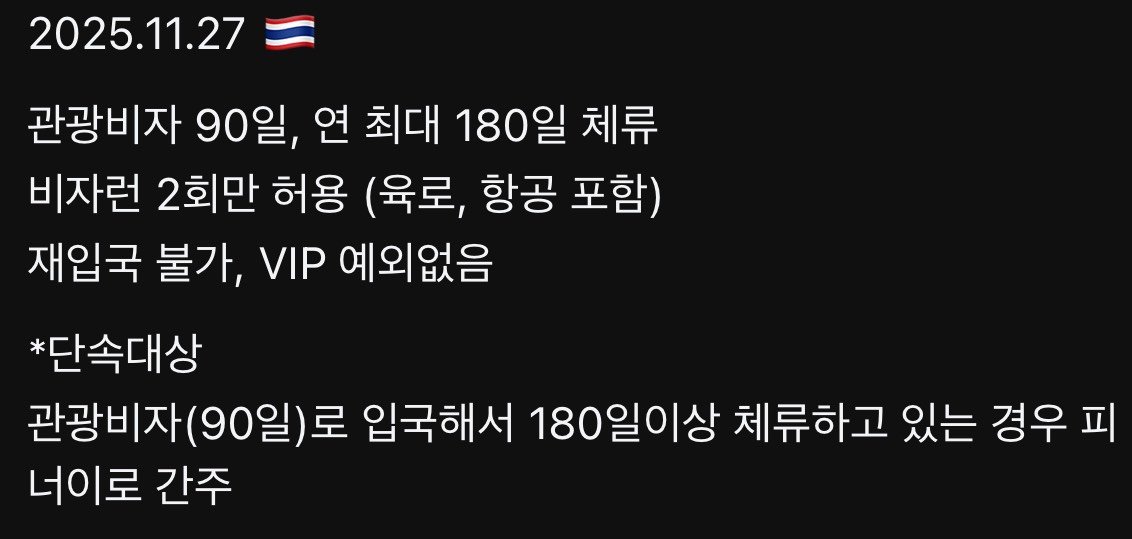
Earlier tonight, we got an image from our Korean friend, showing the message: “free visa 90 days, max 180 days each year, only two visa runs, no re-entry, no VIP exception.”
The first thing they asked was whether it was true, so we told them it is real ✅️.
This became a good time for us to explain what is actually happening behind these rules, because the situation is more complicated than the short message makes it look.
Thai Immigration has already confirmed through its official channels that its main goal now is to close the gaps in the system caused by repeated visa-exempt entries. These new actions are not sudden, and they are not random. They are part of a national plan to stop foreign criminals who use Thailand as a transit point, especially those escaping from scam compounds in the Mae Sot–Myawaddy area. All of this is written in the Immigration Bureau’s 12 November 2025 briefing, the police cybercrime orders, and the national security measures directed by the NSC.
Why These Measures Were Introduced?
The short message our friend received may look very strict, but the background explains why it happened. In its recent update, Thai Immigration said that more than 2,900 people have already been refused entry this year because they used repeated visa runs without a good reason.
These cases were not normal tourists as they usually involved people who showed long-term stay patterns, kept crossing borders without clear purpose, or appeared on immigration watchlists.
At the same time, the Royal Thai Police and the NSC told Immigration to increase security at the borders after Myanmar closed several scammer areas earlier this year. More than 1,440 people entered Mae Sot through natural paths, and many of them had unclear identities, unknown reasons for entering Thailand, or possible links to organised crime.
Because of this situation, Immigration was ordered to improve its biometric records, make NRM screening stricter, and stop anyone connected to those areas from coming back into the country.
Only Two Visa Runs Allowed?
When we look at this bigger picture, the rules about only two visa runs and the limit on re-entry start to make sense. They are not bans aimed at Koreans, Japanese, Chinese, or any other nationality. Instead, they are specific measures designed to close loopholes that criminals have been using for a long time.
How are Real Tourists and Long-Stay Visitors Affected?
We believe that this is where the emotional part appears. Many real tourists, including those who remain in the country for several months, remote workers, and those with Thai partners, often feel they are being treated the same as criminals. Recent discussions on reddit show exactly this mix of confusion, worry, and frustration.
One person shared that:
“Immigration refused entry to around 2,900 foreigners whose records showed more than seven short-term entries and more than 200 days’ total stay in a single year.”
For many long-stay visitors, this number feels like a message that even frequent but harmless travel can now appear suspicious.
Others are really afraid. A frequent visitor wrote:
“This is worrying for me. I do 8 days a month… I guess I’ll find out next Friday how serious they are.”
Another long-stay winter visitor questioned the assumptions behind the policy:
“Where do they get the idea that we all work here? Do they have any idea how much it takes to come and go, stay in hotels for 6 months?”
These are not criminals, they are people spending real money in the country, but the system does not see their intentions, only their pattern.
There are also reports of inconsistent experiences. One tourist who had only entered once earlier in the year said:
“I got pulled aside, put in the holding pen, and checked for my return ticket.”
Another shared a much harsher outcome:
“I have been in Thailand 3 times this year… this time I was denied entry.”
Even tourists who followed the rules, with onward tickets and hotel bookings, described being refused without clear explanation.
For people who visit often but only stay short periods, the uncertainty is just as strong. A frequent tourist who enters five times a year wrote:
“I know I’d most likely be let through, but no way I am going to risk the off chance some immigration officer is having a bad day.”
This sense of unpredictability makes real tourists feel vulnerable, because they cannot control how their travel pattern is interpreted.
Some commenters also believe that the current tightening misses the real problem. One wrote:
“Actual scammers can just pay for VIP fast track and get in with no questions asked.”
Another added an experience of watching:
“A dedicated line where a Thai guy opens it every few minutes for a 25–40-year-old Chinese guy travelling alone, 5K, no questions asked.”
These comments reflect a perception that sincere tourists are the ones facing the stricter checks, while those with bad intentions may still find ways around the system.
Altogether, these voices show why the emotional side matters. People who love Thailand, spend money here, and follow the rules now feel caught between a policy designed to stop scammers and the reality that they may be questioned, delayed, or even denied simply because their travel habits look unusual on paper. For them, the fear is not about wrongdoing, it is about being misunderstood.
From what Thai Immigration has published, it seems it somehow understands these worries. It says that real tourists are still welcome and that the aim is to bring in “quality tourists”, not to punish people who simply enjoy living in Thailand.
But Travel Patterns Still Matter.
If someone uses only visa-exempt entries and stays close to 180 days every year, this pattern looks unusual to Immigration, even if the person’s reasons are honest.
Officers do not have enough time to check every story in detail, so they rely mainly on the travel history. That is why many visa runners feel worried. They are not doing anything illegal, but their lifestyle, remote work, long visits, cross-border relationships, does not always match the official visa categories. Some feel stuck between rules that were never created for people who live partly in Thailand and partly abroad.
In short:
Thai Immigration’s new limits on visa runs and yearly stay are real and come from a national effort to stop criminals abusing visa-exempt entries, especially those linked to scam networks. Real long-stay visitors and remote workers are not the target, but their frequent travel patterns can still look suspicious.
Thai Free Visa: Feel free to reach out to us anytime. We are here to help whenever you need.