
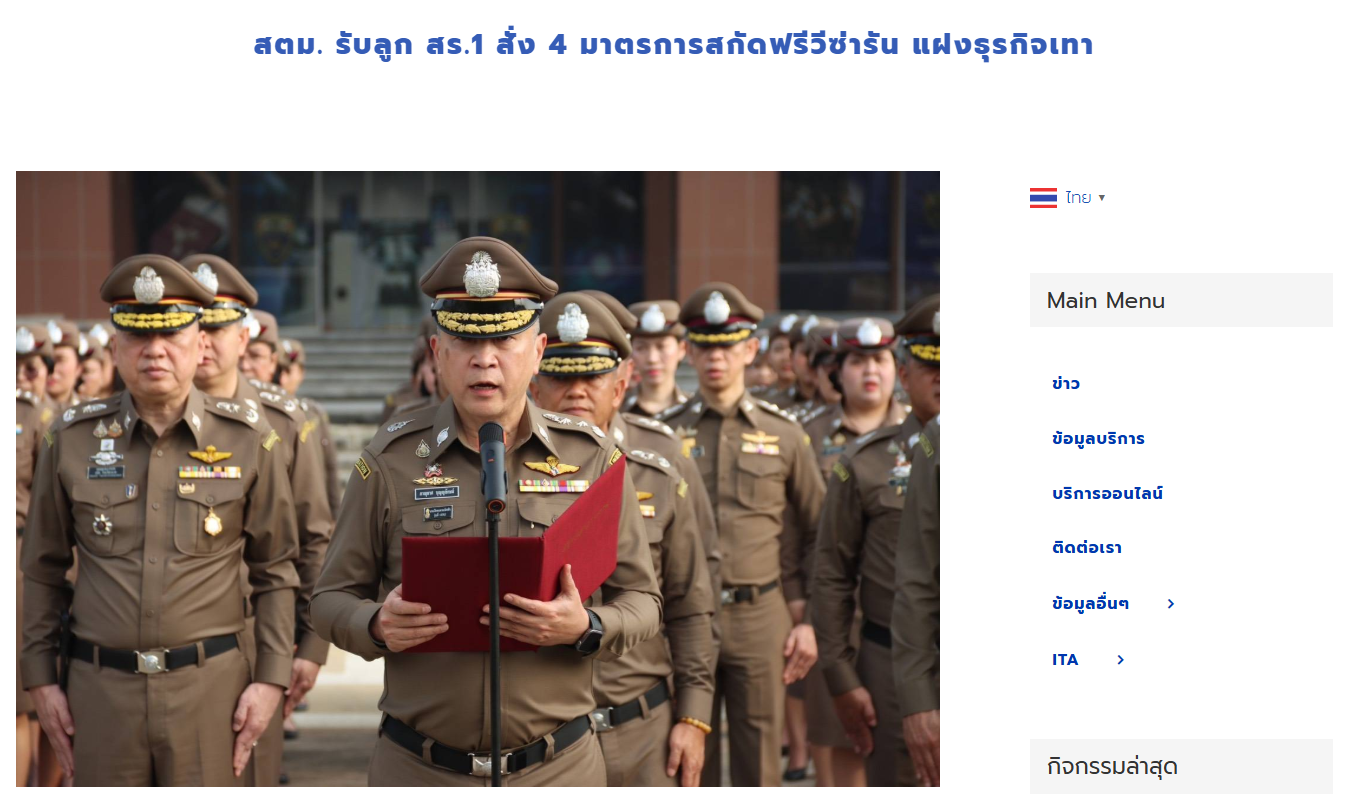
Thai Immigration published an article on 12 November 2025, stating that the authorities are tightening controls on foreigners who abuse visa-free entry and carry out repeated visa runs, particularly those connected to cybercrime and scam networks. It outlines four key measures focusing on frequent visa runners, people flagged for scam activity, suspicious visa-extension requests, and overstay cases, while emphasising that real tourists remain fully welcome in Thailand.
The Reasons Behind Thai Immigration’s Stricter Approach
What really caught our attention in this article is the way Thai Immigration explains its new measures and the reasons behind its stricter approach.
The strongest focus is on the measure that deals with stricter screening of people who repeatedly use visa runs. Immigration says this is now a top priority, with tougher checks at both borders and airports, refusals for anyone doing two or more rounds without a valid reason, and more than 2,900 refusals already recorded since early 2025. It also explains in simple terms how some foreigners misuse the free-visa or visa-exemption scheme, entering over and over again instead of applying for the correct visa, creating loopholes that Thailand now wants to close. Another interesting point is Thai Immigration’s focus on blocking re-entry for foreigners linked to scammer zones in the Mae Sot–Myawaddy area. Anyone previously flagged in watchlists or deported from those areas will now face automatic refusal.
Thai Immigration also puts everything into context, linking these actions to the government’s broader war on cybercrime, led by PM Anutin and Police Chief Kittirat, who instructed Immigration to intensify operations. Moving on, Thai Immigration explains that provincial Immigration offices will start denying or revoking visa extensions for people who show clear visa-run patterns. Thai Immigration also discusses the nationwide crackdown on overstayers, with efforts to identify, track, and deport them, plus public updates on the results. Finally, it reassures legitimate tourists that these measures are not aimed at them. It mentions that processing times may be slightly slower due to additional checks, a maximum of around 45 seconds per person, but tourism itself is not affected. The focus, as it emphasises, is on attracting quality tourists.
Visa Runners’ Perspectives
Many visa runners might walk away feeling both hopeful and worried, influenced by the sense that Thai Immigration doesn’t fully understand them.
 A common thought might possibly be “I’m not a criminal”. “I just really love living in Thailand”. Many of these people are long-stay visitors, remote workers, or people with partners here, and they may feel discouraged when they see themselves being placed in the same category as scammers or cybercriminals. Their reasons for staying are usually about lifestyle, relationships, or personal preference, not anything illegal.
Another feeling they might have is that the rules are confusing or simply don’t fit their real-life circumstances. It’s not that they reject Thailand’s right to manage its borders. Rather, they often find the visa options complicated, slow, or impractical for someone who is a digital nomad, in a cross-border relationship, or waiting for another type of visa to be approved.
For them, visa runs become a workaround, not because they want to bend the rules, but because they see no straightforward option that truly matches their situation.
Some would also say that they are fully willing to follow the law, if only the path forward were clearer. If Thailand offered simple long-stay options, many would choose those over the stress and uncertainty of constantly exiting and re-entering the country. The truth is, most visa runners don’t enjoy spending money and time on border hops. They just feel they have no better choice.
New Measures Leave Visa Runners Uneasy
These updated rules may leave many visa runners feeling uncertain. Even if they have done nothing wrong, they might worry that frequent entry-and-exit patterns alone could lead to a refusal. The fear of an unpredictable decision at the borders and airports can make it difficult for them to plan their work, their relationships, or even their long-term future in Thailand.
Ultimately, many hope that officers will look beyond simple patterns and consider people’s intentions, evidence, and personal context. They want to be seen not as risks, but as people who really appreciate the country and want to stay in a way that respects the law.
Meanwhile, people would hope that Immigration looks at more than just how many times someone has crossed the border. They may wish officers would consider the full picture of their life, whether they have a stable online job, reliable financial support, or a Thai partner or family who anchors them here. They might want their clean criminal record and lack of suspicious behaviour to count for something, too. For people who have transparent reasons for staying, there is a hope that these factors will help distinguish them from those involved in grey business. At the same time, many visa runners understand that relying on the visa-exempt entry over and over again carries its own risk.
TFV’s Perspectives
For those of us working in green-corridor and VIP-clearance services, these new measures create both challenges and opportunities. Many of us feel that careful screening of clients has suddenly become even more important. If a guest has a long record of visa runs, past overstays, or unclear travel intentions, the risk of refusal becomes much higher, and that risk doesn’t just affect the traveller, it reflects directly on the service provider’s reputation.
For companies that rely on trust and efficiency, this is something they cannot take lightly.
At the same time, professional providers are likely to emphasise that their role is to facilitate travel within the legal framework, not to bend or bypass the rules. With Immigration becoming more vigilant about grey businesses and cybercrime, VIP teams feel the need to draw a clear line between what they do, escorting legitimate travellers smoothly, and any perception of helping someone avoid scrutiny. This shift also increases the responsibility they feel toward both guests and partner agents.
Many VIP service teams work closely with travel agencies, corporate planners, and intermediaries. Now they feel a stronger obligation to guide them properly: explaining which client profiles pose higher risks, warning travellers who have done multiple visa runs that they may face additional questions, and encouraging long-stay guests to obtain the correct visa rather than rely on last-minute fixes.
Clear Communication is Important.
Clear communication becomes a form of protection for everyone involved. Good coordination with Immigration officers becomes equally essential. With the four new measures in place, VIP service providers will want accurate, up-to-date information about watchlists, NRM or scam-related systems, and the types of travel patterns that tend to trigger extra screening. They will also want to know which supporting documents can help real travellers explain their purpose clearly. When both sides communicate well, unexpected issues at the counter can be prevented, and awkward or embarrassing situations for VIP clients can be avoided. These changes also mean that expectations around speed may need to shift.
In the past, VIP services often focused on being extremely fast. Today, they understand that stricter checks may add a bit of time, especially for clients whose profiles naturally raise more questions. Because of this, many providers will adjust their internal processes and marketing to highlight reliability, compliance, and smooth handling, rather than promising pure speed above all else. In the long term, though, many providers may see these changes as beneficial. If Thailand becomes known for actively filtering out scammers and criminal networks, VIP clients who are real travellers, businesspeople, or high-net-worth tourists may actually feel safer and more confident using these services. A stricter system can, in the end, build trust, both for the country and for the companies that help people enter it.
In Short:
If you’re someone who comes in and out of Thailand often on a free-visa entry, it’s completely natural to feel uneasy when you read news about Immigration cracking down on visa runs, scammers, and cybercrime.
But it’s important to understand the real intention behind these measures.
The people being targeted are not ordinary visitors who follow the rules and simply enjoy living or travelling in Thailand. The focus is on those who hide illegal activities, especially online scams and other serious offences, behind repeated visa-exempt entries. Still, even if you are doing everything properly, your travel pattern can influence how an officer sees you.
If you enter many times in a row, contact us.
Immigration officers have the authority to ask more questions, and in some cases, to refuse entry if your explanation does not seem convincing. So if you love Thailand and want to stay here in a way that’s safe and completely above board, there are a few things we could do that can make your experience smoother.
However, please be open and honest about your situation. When we ask about your purpose of stay, it’s better to answer clearly and straightforwardly. If you work online, explain that. If your partner or family is here, say so. If you’re between visas, share that honestly. What usually causes problems is when someone gives answers that sound rehearsed or inconsistent.
It’s also important to stay away from anything that might be considered grey activity. Even if you’re not directly involved in wrongdoing, simply being around people or environments linked to illegal operations can put you at risk, especially now that Immigration is paying very close attention to networks connected to scam compounds or cybercrime.
And finally, it’s worth remembering that the Immigration officer at the border always has the final say. Every country has that right.
The more your travel pattern looks like a long-term stay without a proper visa, and the less clear your explanation is, the higher the chance of refusal. This reality can be stressful, but understanding it helps you prepare and make better decisions for your long-term plans. In the end, if you follow Thai laws, avoid any questionable activities, stay honest about your intentions, and move toward obtaining a visa that actually matches your lifestyle, there is no need to panic.
Main Source:
Immigration Bureau. (2025). Immigration Bureau follows NSC directives, ordering four measures to block free-visa runs linked to grey businesses. [Thai]. Retrieved November 27, 2025, from https://www.immigration.go.th/?p=34106